My Verdict: The Traffic Acquisition Blueprint (AI Toolkit) is worth considering if you want content to adapt for an existing marketing audience. I would buy it for the preparation work it could save, provided I had a clear use for it.
The combination of educational material, AI companion guides, and promotional assets is appealing. But its value depends on the quality of the downloadable content and what you contribute before publishing.
In this Traffic Acquisition Blueprint review, I’ll explain what you get, how its private label rights work, what you may need beyond the purchase, and when I would choose another approach.
Affiliate disclosure: This article may contain affiliate links. If you purchase through them, BuyWiseHQ may earn a commission at no additional cost to you.
Review transparency: This is a research-based review of the official product information and published terms. I have not purchased the package, inspected its downloadable lessons, or tested customer support.
What Exactly Is the Traffic Acquisition Blueprint?
The Traffic Acquisition Blueprint (AI Toolkit) is a downloadable educational content package from PLR Experts. It covers attracting potential customers through a range of marketing channels and includes materials for packaging and promoting a finished digital product.
Its private label rights license allows certain forms of customization and commercial use.
The Traffic Acquisition Blueprint Review
| Item | Product overview |
| Product | The Traffic Acquisition Blueprint (AI Toolkit) |
| Provider | PLR Experts |
| Product type | Downloadable PLR training and marketing materials |
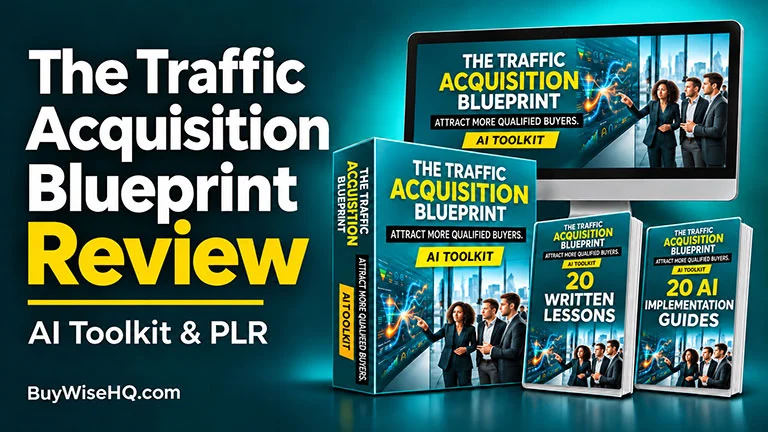
| Main content | 20 written lessons and 20 AI implementation companion guides |
| Topics | Paid advertising, social promotion, viral marketing, and offline customer acquisition |
| Document formats | Editable DOCX files and PDFs |
| Marketing assets | Covers, sales and lead-capture templates, delivery pages, affiliate resources, banners, and promotional emails |
| Intended users | Content creators, marketers, consultants, and publishers serving a relevant audience |
| Advertised entry price | $5; a separate official pricing graphic lists $7–$10 |
| License | Rebrand and distribute permitted finished products; restrictions apply |
| Refund policy | All sales final; no refund advertised |
| Official product link | View The Traffic Acquisition Blueprint |
These are advertised inclusions, not independently tested results. The final checkout price was not verified.
The key distinction is simple: you are buying content and publishing assets. This is not an application that sends traffic to your website or manages advertising campaigns.
What Does the Traffic Acquisition Blueprint Actually Do?
Its main purpose is to reduce the work involved in preparing a small educational offer.
You could adapt the material into a downloadable guide, an email signup incentive, a relevant bonus, or a low-priced introductory product.
I would assess its usefulness in three parts:
The lessons provide starting material. Their value depends on whether reviewing and improving them takes less work than creating something suitable yourself.
The AI guides are intended to support implementation. They are advertised as ChatGPT-oriented resources containing prompts, examples, and exercises.
The marketing assets provide a publishing starting point. Templates can help with presentation, but you still need to connect the offer to your own delivery and promotional setup.
None of those components establishes demand. You need a reason for a particular reader to want the finished resource.
How Does It Work?
My approach would be to start with the audience, then work through the files.
Step 1: Choose one problem to address. Decide what the reader should understand or accomplish.
Step 2: Inspect the relevant lessons. Check accuracy, clarity, examples, and references to advertising platforms.
Step 3: Customize the content. Remove unnecessary sections and add explanations that suit your audience.
Step 4: Prepare the finished product. Update the branding, format the material, and follow the license.
Step 5: Connect delivery. Set up your signup form or payment process and customer access.
Step 6: Test before promotion. Confirm that links, forms, downloads, and follow-up messages work.
Prepared HTML pages do not automatically provide hosting, email delivery, payment processing, or affiliate tracking. Those connections still need attention.
For that reason, I would not schedule a launch around the assumption that everything can be completed in an hour.
What Do You Get Inside?
Written lessons and AI companion guides
The advertised core is 20 written lessons paired with 20 implementation guides.
The curriculum covers a broad mix of channels, including paid advertising, referrals, blog advertising, and offline promotion.
That breadth offers choices, but I would not assume every lesson belongs in the same finished product. Selecting the most relevant material could make the result more useful.
I cannot verify the lessons’ depth or the quality of the prompts without inspecting the downloads.
Product and marketing templates
The package lists editable covers, promotional banners, email copy, and templates for sales, lead capture, delivery, and affiliate resources.
These could save preparation time if their format suits your existing setup. However, an affiliate information page does not recruit partners or operate an affiliate program by itself.
I would also review promotional copy carefully before publishing it. Any claims made under my branding would need to be accurate and supportable.
An unresolved question about videos
Some official promotional information mentions 20 video lessons. The detailed product inventory instead emphasizes written lessons and AI guides.
I could not confirm that videos are included. If video delivery is important to you, ask the provider before purchasing.
What Is PLR, and How Can It Be Useful?
PLR stands for private label rights. It describes permission to adapt existing content under a particular license.
The exact permissions matter more than the label. Different packages can have different restrictions.
Here, the practical opportunity is to take prepared material and develop a finished resource for your readers. You can spend more time selecting, explaining, and improving the content instead of starting with an empty document.
That can be useful. It can also become a habit of collecting files without publishing anything.
Changing the cover is not enough
My standard for using PLR would be whether I have made the content more helpful for a specific audience.
For example, a broad marketing resource could become a focused guide for local service providers. I could add an original planning worksheet, explain which channels fit that audience, and include examples I understand well enough to stand behind.
Those contributions give the finished product a clearer purpose.
A new title and logo may change the presentation, but readers still need a reason to choose the material and trust its advice.
Keep the educational promise realistic
I would avoid describing a short introductory guide as comprehensive professional training unless the content supports that claim.
A modest resource can be valuable when it helps someone complete a manageable task. It does not need to promise a complete business transformation.
The Main Question: Can You Turn This into Something People Want?
For me, this matters more than the number of included assets.
“Traffic” is a broad topic. A local business seeking inquiries, a blogger building readership, and a creator selling a course have different priorities.
Trying to serve all of them with the same general resource can make the offer harder to explain.
I would narrow the product around one audience and one useful outcome.
For example, I might create a guide that helps a small service business plan its first customer-acquisition experiment. It could walk through choosing an audience, selecting a channel, developing a message, and deciding what result to measure.
That is my suggested adaptation, not a description of a verified exercise inside the package.
The buying decision then becomes clearer: does the supplied material help me create that resource efficiently?
Where the AI component could Add Value
An effective AI exercise should do more than ask for a generic advertisement.
It should help the reader supply context, review the output, and make sensible choices. Relevant details might include the audience, offer, evidence, budget, and desired next action.
I would test the companion guides against that standard before making “AI-powered” the main attraction of my own product.
What I Like About the Offer
It gives a publishing project a starting point
Having prepared material can help someone move from planning to editing and publishing.
That is most useful when the buyer already knows what they want to produce. A clear brief makes it easier to decide what to keep, rewrite, or remove.
It combines educational and promotional materials
Creating a digital resource involves more than writing its contents.
If the supplied assets are suitable, having documents, graphics, and promotional templates together could reduce preparation work.
It could support a focused introductory offer
I like the potential for creating something small and useful that introduces readers to your approach.
A consultant, for example, could offer a resource that helps prospects understand a problem before discussing a service. The resource should still be useful to people who never become customers.
What I Would Be Careful About
The quality remains unverified. A detailed list of deliverables cannot establish how clear, accurate, or practical the actual content is.
Advertising advice requires review. Platform features and processes change. I would check any implementation instructions before passing them to readers.
Broad coverage can become unfocused. More topics do not automatically create a better learning experience.
Prepared marketing materials still need editing. I would remove unsupported claims and make the wording consistent with what my finished product delivers.
Publishing creates customer responsibilities. If you sell the resource under your brand, readers will expect you to answer questions and resolve delivery problems.
These are manageable considerations for an experienced publisher. They are also reasons to keep the first project small.
The Traffic Acquisition Blueprint Pricing and Upgrades
The public pricing information reviewed on November 2, 2026, was inconsistent.
| Offer | Advertised price | What is confirmed |
| Main package | $5 in the product description; $7–$10 in a separate pricing graphic | The detailed inventory describes the base content package |
| Upgrade 1 | $37 | Contents not verified |
| Upgrade 2 | $77 | Contents not verified |
| Upgrade 3 | $37 | Contents not verified |
These are advertised amounts, not a completed checkout quote.
I would check the final price and selected items before paying. I would also evaluate each upgrade separately rather than assuming it is necessary.
Without verified upgrade details, there is no sound basis for recommending the complete purchase sequence.
What Will It Really Cost to Use?
The purchase price is only one part of the decision.
Depending on your project, you may also need:
- Website hosting or a platform for delivering the resource.
- Email software if you plan to collect subscribers.
- Payment processing if you sell the finished product.
- Tools for editing documents or graphics.
- A separate budget for any paid promotion.
You may already have these tools. Editing and testing still take time.
My value calculation would be whether the package reduces the work required to produce something useful. A low acquisition cost does not help much if most of the content needs replacing.
License and Refund: What You Need to Know
The published license permits rebranding and selling finished PDF content. It also allows uses such as lead magnets, bonuses, membership content, and creating additional finished formats.
However, it prohibits giving away or selling the editable source files and passing on private label rights, master resale rights, or resale rights.
You can create a permitted finished product for end users; you cannot assume you can redistribute the source package to other resellers.
Keep a copy of the license supplied with your purchase, particularly if you plan to adapt the content into another format.
The stated refund policy is also clear: all sales are final, with no refund offered for this package.
I would resolve any questions about videos, file formats, or intended usage before purchasing.
What Are the Alternatives?
The right alternative depends on whether you want to learn marketing or create something to distribute.
| Alternative | When I would choose it | Main trade-off |
| Google Skillshop | I want to learn Google Ads | Platform-focused education rather than material to rebrand |
| HubSpot Academy | I want broader digital marketing education | Learning still needs to be translated into my own project |
| A small original guide or worksheet | I know a specific question my audience needs answered | More original writing and preparation |
| A commissioned resource | I have a clear brief and need tailored content | Requires a budget and editorial oversight |
Google offers free Google Ads training through Skillshop. HubSpot Academy offers a free digital marketing course covering areas such as content, search, social media, and measurement. These are learning alternatives, not substitutes for a PLR license.
For a lead magnet, I would also consider whether a shorter original resource could do the job better.
A useful checklist based on a recurring audience question may be easier to position than a broad training bundle. I would choose PLR when it meaningfully reduces production work while supporting the result I want.
Also Check:
Who Should Buy It—and Who Should Skip It?
Consider it if you:
- Already serve an audience interested in marketing or customer acquisition.
- Have a specific finished resource in mind.
- Are comfortable editing, checking, and publishing content.
- Want permitted finished-product usage rather than transferable resale rights.
- Accept the stated refund terms.
Skip it for now if you:
- Expect the purchase to generate traffic automatically.
- Are still unsure whom you want to serve.
- Need confirmed video lessons.
- Want to distribute editable files or sell PLR rights.
- Plan to publish the material without reviewing it.
My Final Verdict: Is The Traffic Acquisition Blueprint Worth Buying?
I would consider the base package for a clearly defined publishing project, after confirming any details that affect the purchase.
The potential benefit is saving preparation time. The deciding factor is whether the content can be developed into something useful enough to put my name on.
I would inspect it, narrow its purpose, improve its examples, and test the finished delivery experience before promoting it.
If you already know your audience and what you want to create, this could be a practical starting point. If those decisions are still missing, I would make them before buying more content.
My confidence is strongest in the published offer and licensing terms. Content quality, support responsiveness, and real-world results remain unverified, so I am not assigning a hands-on performance score.
Frequently Asked Questions
Is The Traffic Acquisition Blueprint software?
No. It is a downloadable educational content package with AI companion guides and marketing assets.
Does it generate traffic automatically?
No. You still need to implement marketing activities, reach an audience, and evaluate results.
Can I rebrand and sell the content?
Yes, within the published license. Permitted finished products can be sold, but editable files and resale rights cannot be transferred.
Can I use it as a lead magnet?
Yes. The published permissions include using finished content to collect leads.
Are video lessons included?
That remains unclear. Some official information mentions videos, but the detailed inventory does not confirm them.
Do I need all the upgrades?
I could not verify their contents or establish that they are required. Buy an upgrade only when its specific benefits fit your project.
Is there a money-back guarantee?
The published policy states that all sales are final and no refund is offered for this package.
Is this review based on firsthand testing?
No. It is based on official product information and published terms. I have not inspected or tested the paid downloads.