My verdict: WAIT. Pin2Profit AI has a useful idea behind it: reduce the work involved in preparing Pinterest campaigns for Amazon products. But I would clarify its AI costs, base-version limits, and publishing requirements before buying. I would be especially cautious about purchasing the full upgrade bundle.
The most concrete concern is the pricing presentation. The supplied marketplace prices imply a different bundle saving from the one advertised. There are also conflicting descriptions of what the bundle includes.
Affiliate disclosure: BuyWiseHQ may earn a commission if you purchase through affiliate links in this review. This does not change your price or determine my verdict.
| Quick BuyWise verdict | Assessment |
| Verdict | WAIT — clarify the operating requirements first |
| Evidence level | Research-Based |
| Hands-on testing | None |
| Numerical score | Not assigned |
| Recommendation confidence | Medium; product-performance confidence remains low |
| Documented entry price | $27 launch price; live checkout total not independently confirmed |
| Potential best fit | An existing Amazon Associate whose main difficulty is producing Pinterest content |
| Main attraction | Bringing campaign preparation into one workflow |
| Biggest uncertainty | Whether the base version delivers a useful, affordable workflow after setup, editing, and publishing |
| Get Pin2Profit AI | Pin2Profit AI |
My Honest Pin2Profit AI Review: Should You Buy It?
Research date: October 20, 2026
I reviewed the supplied marketplace screenshots, the creator’s public explanation, accessible official-page information, competitor coverage, and relevant Pinterest and Amazon documentation. Some official pages were readable only through indexed excerpts, and I could not independently inspect the final checkout.
I have not purchased Pin2Profit AI, generated campaigns with it, contacted support, or tested refunds. This review makes no claims about personal traffic, earnings, output quality, or time saved.
What Exactly Is Pin2Profit AI?
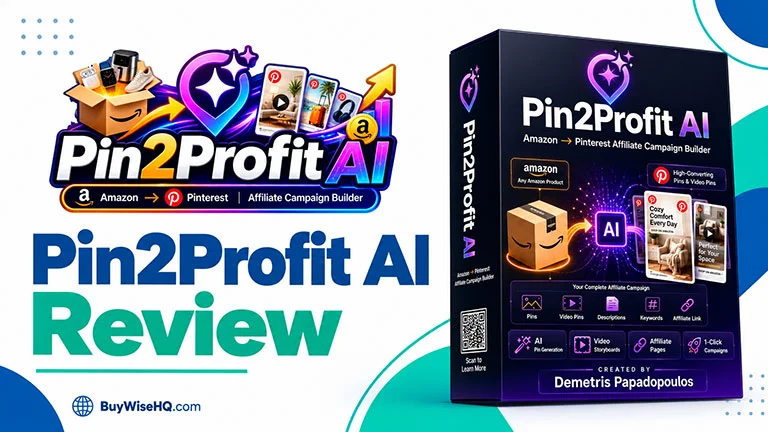
Pin2Profit AI is a cloud-based marketing tool designed to help Amazon affiliates prepare promotional campaigns for Pinterest. You enter an Amazon product URL, and the software is marketed as helping you create the content needed to promote that product.
Its creator, known as DPAPA, presents it as a way to bring several campaign-building tasks into one browser-based application. You don’t need to install desktop software.
The simplest way I’d describe it is an AI-assisted campaign builder. You still need products worth recommending, an appropriate affiliate setup, and a plan for reaching potential buyers.
What Does Pin2Profit AI Actually Do?
According to the vendor, Pin2Profit AI helps turn product information into Pinterest marketing materials, including:
- Campaign ideas: Different angles for introducing a product to an audience.
- Pin graphics and copy: Images, headlines, descriptions, and calls to action.
- Keyword and board suggestions: Ideas for organizing and describing your content.
- Affiliate pages: Supporting pages that visitors can view before following a product link.
- Asset organization and analytics imports: Tools for keeping campaign materials together and reviewing imported performance information.
These are advertised capabilities. I have not independently tested their quality or reliability.
The potential benefit is less time moving between separate writing, design, and page-building tools. But the finished material still needs your judgment. An attractive graphic can misrepresent a product, and convincing copy can contain a claim the product listing does not support.
I would judge its usefulness by how much work remains before a campaign is ready to publish.
How Does Pin2Profit AI Work?
The vendor describes a workflow that starts with an Amazon product URL and ends with campaign materials you can review and publish. The basic version requires manual Pinterest publishing; direct publishing is described as a Pro Suite feature.
Here is how I would approach that workflow:
- Choose a relevant product. Start with something your audience has a reason to consider.
- Enter its Amazon URL. Check that the imported information describes the correct product and variant.
- Generate the campaign materials. Review the proposed promotional angle, visuals, copy, and destination page.
- Correct the output. Check product accuracy, affiliate tracking, disclosures, and mobile presentation.
- Publish through the available route. Confirm what your purchased version supports before assuming publishing is automated.
- Measure the response. Track outbound clicks and qualifying purchases, then decide what deserves improvement.
Those checks are my recommended working process, not steps I have personally completed inside Pin2Profit AI. I have not verified the full setup process or the amount of editing a typical campaign requires.
Is the $27 Version Enough?
Possibly for preparing a small campaign, but don’t assume it includes direct publishing.
The creator’s explanation says the base version requires manual Pinterest publishing and processes campaigns individually. It places direct publishing, bulk generation, and video pins in Pro Suite.
That distinction matters. Preparing a posting schedule, exporting campaign files, and actually publishing posts are separate functions.
At the supplied prices, the base product plus Pro would cost $74. If publishing from inside Pin2Profit AI is essential to you, that is the more relevant starting figure—subject to confirmation of the current offer.
I wouldn’t automatically upgrade, though. Pinterest already provides native scheduling for business accounts and a CSV bulk-creation option. Its documentation describes scheduling up to 30 days ahead, with up to 10 Pins scheduled for the future, and bulk uploads of up to 200 images or videos. Pin2Profit AI’s exported files would still need testing for compatibility.
For someone publishing occasionally, an export-and-upload workflow might be acceptable. For someone managing an established content operation, the extra handling could undermine the promised saving.
My unanswered question is whether a new customer can complete one usable campaign with the base purchase alone, including image generation and a working destination page. Public descriptions do not settle every part of that question.
Pin2Profit AI Pricing: Check the Bundle Arithmetic
These prices come from the WarriorPlus product-list screenshot supplied for this review. Treat them as a documented launch snapshot rather than a guaranteed current checkout price. The official JV listing also advertises the $27 front end.
| Product | Listed price | What would justify considering it? |
| Base product | $27 | A demonstrated improvement in your campaign-production process |
| Professional Suite | $47 | A confirmed need for its additional publishing or production functions |
| Intelligence Toolkit | $37 | Research data whose sources and usefulness you can evaluate |
| DFY Suite | $37 | Sample materials you would genuinely use and adapt |
| Paid Ads | $47 | A clear plan for testing advertising economics |
| Agency | $97 | An existing client-service need and suitable licensing terms |
| VIP Bundle | $247 | A genuine need for enough upgrades to justify the total |
The advertised saving does not match these prices
The five individual upgrades total:
$47 + $37 + $37 + $47 + $97 = $265.
Compared with that total, a $247 bundle saves $18.
However, the indexed official bundle page advertises a $322 individual-upgrade total and a $75 saving. That might reflect a different price configuration, but it does not match the supplied marketplace snapshot. I could not reconcile the difference through a live checkout.
There is also an inclusion conflict. The creator’s article describes the bundle as including the base product. The official bundle-page excerpt explicitly says it excludes the front end, which must be purchased first. I would use the offer-specific exclusion for budgeting until checkout confirms otherwise.
On that basis:
- Base plus all five upgrades separately: $292.
- Base plus VIP Bundle: $274.
- Difference: $18, before any applicable tax or additional service costs.
The screenshot contains two VIP Bundle entries. I have not counted them as two necessary purchases; the screenshot alone does not establish that.
My advice is to ignore the advertised saving until you know which upgrades you need. Spending $247 on features you won’t use is not a saving over buying only the base product.
Does “Free AI” Mean No Running Costs?
I wouldn’t budget on that assumption yet.
The creator’s FAQ says customers do not need their own AI API keys. Meanwhile, indexed official sales material describes free generation alongside optional external providers, and the JV material mentions bringing keys for video and advanced text. These statements could describe different functions, but the boundaries need clarification.
Some competitor coverage also promotes a specific free-image allowance. I would not adopt that number as a dependable operating limit without current provider documentation and confirmation of the exact model used.
Google’s API pricing distinguishes between models and paid or free access. Its published Nano Banana/Gemini 2.5 Flash Image pricing does not establish a universal free-image allowance. That does not prove Pin2Profit AI’s included generation is unavailable; it means the advertised free route needs a more precise explanation.
Before buying, I would want three concrete answers:
- Which image-generation service works without a separately funded account?
- What limits apply to that included service?
- Which actions trigger charges from another provider?
A useful first-year cost estimate is therefore:
Software purchases + any AI usage + any hosting or storage + optional advertising + applicable taxes.
I cannot responsibly put a fixed number on the whole year. The unresolved costs depend on your workflow, providers, and usage.
The Bigger Question: Can You Turn the Output Into a Viable Affiliate Campaign?
This is the part I would investigate before producing dozens of campaigns.
The software can help prepare promotional material. Whether you can publish and monetize that material depends on decisions and platform requirements outside the generator.
A Pinterest account alone does not settle Amazon eligibility
Amazon’s US application-review guidance does not list Pinterest among the social networks it currently accepts for applications. It also requires qualifying sales during the initial review period and evaluates the original content on submitted sites.
That does not establish a blanket ban on Pinterest traffic. It does mean a beginner should not assume that opening a Pinterest account and buying this software creates an approved Amazon Associates business.
If you already operate an eligible website, Pinterest could be part of your traffic plan. If you are starting with nothing, establish your Associates eligibility and publishing destination first.
A generated landing page also needs a reason to exist. Would a visitor learn something useful there, or simply encounter a rewritten product description and a purchase button?
That is the standard I would apply before sending traffic.
More account slots are not permission to scale indiscriminately
Pinterest’s affiliate guidelines generally recommend one authentic account. They require original, useful affiliate content and warn against repetitive or high-volume affiliate posting and attempts to manipulate distribution.
I would therefore avoid valuing an upgrade simply because it supports more accounts.
For a legitimate agency managing separate clients, the context may be different from one affiliate opening many near-identical niche accounts. A software account limit does not determine what Pinterest permits in your particular situation.
The same applies to posting frequency. Having the capacity to generate more content does not tell you how much useful content you can publish responsibly.
The destination page needs more than a good layout
Amazon requires clear affiliate disclosures and identification as an Associate. Its guidance explains that disclosures should be noticeable near the relevant recommendation or link.
I would inspect the generated page for those elements, correct tracking links, accurate product information, and a usable mobile layout.
I would also establish who controls the published page. Can you edit or export it later? What happens if you stop using the software? Does hosting require another account?
I could not verify those details for the base version. They matter because a campaign’s links can outlast the initial software purchase.
Sales Claims vs. Reality
A fast generation time is not the same as a finished campaign
The creator advertises campaign generation in under two minutes. I have not reproduced that timing.
The useful measurement would include checking facts, fixing images, editing copy, preparing the destination, publishing, and verifying the links.
A quick first draft could still be valuable. But if corrections take longer than creating the material yourself, the generation speed becomes a poor buying metric.
Attractive graphics still need product verification
For an Amazon product campaign, I would inspect whether AI-generated scenes preserve the correct shape, accessories, scale, and intended use.
A polished image of a kitchen appliance with an invented attachment could mislead a buyer. Equally, a convincing lifestyle image does not demonstrate that the product performs as shown.
These are possible failure points to test, not faults I have observed in Pin2Profit AI.
The copy deserves the same scrutiny. I would remove unsupported performance claims, invented comparisons, and statements that imply personal testing when none occurred.
Keywords and trend labels need evidence
Before paying for research features, I would ask where the data comes from and how recently it was updated.
Suggested phrases can be useful brainstorming material. A displayed search-volume or competition figure needs a defensible source before I would use it to allocate a campaign budget.
I have not verified the accuracy of Pin2Profit AI’s research data. That is why I would postpone the Intelligence Toolkit until I could inspect examples against information I already trust.
Can Pin2Profit AI Pay for Itself?
Possibly. I found no independently verified evidence that establishes typical buyer earnings.
Here is an illustrative calculation, not an Amazon commission quote or a forecast.
Suppose a qualifying order averages $50 and earns a 3% commission. That produces $1.50 per order.
| Software spend | Qualifying orders needed to cover it at $1.50 each |
| $27 base product | 18 |
| $74 base plus Pro | 50 |
| $274 base plus VIP | 183 |
These figures exclude other expenses, refunds, and your time. Actual commission rates and qualifying purchases vary.
The exercise shows why the entry purchase and the full bundle deserve different decisions. The higher spend creates a larger amount to recover before you have established that the workflow attracts buyers.
For paid advertising, I would calculate earnings per visitor before scaling. For example, a hypothetical $1.50 commission and 5% purchase conversion would produce only 7.5 cents per visitor reaching Amazon, before other costs. A landing page introduces another conversion step.
That is not a prediction of your results. It is a reminder to calculate what traffic is worth before paying for more of it.
Impressions and saves may help diagnose content performance. They do not, by themselves, show that a campaign has recovered its costs.
What About Refunds and Customer Support?
Indexed official sales material advertises a 30-day money-back guarantee, and the bundle page makes a similar promise. I could not verify the complete checkout conditions, the actual refund process, or how reliably requests are handled.
I would save the terms shown at purchase and confirm the support contact before paying.
A guarantee can reduce purchase risk, but it should not replace checking whether the product fits your needs. It also should not be assumed to reimburse payments made to separate AI, hosting, or advertising providers.
The accessible search results did not give me a reliable body of independently corroborated customer experiences. Several supplied community links were inaccessible. I therefore cannot establish a meaningful pattern of satisfaction, complaints, or refund outcomes.
That uncertainty supports caution. It does not support calling the product a scam.
Alternatives Worth Comparing
| Alternative | When I would consider it | Trade-off |
| Your existing design tools plus Pinterest’s native scheduler | You want to validate a small campaign before buying another platform | More manual preparation |
| Pinterest’s native CSV bulk creation | You already have finished assets and need an upload workflow | You must prepare compatible files and review errors |
| Tailwind | Your main need is Pinterest content creation and scheduling | Compare current plans, limits, and ongoing costs |
| Your existing website and editorial workflow | You already have useful product content and need promotional visuals | Less centralization, but fewer new dependencies |
Pinterest documents the native scheduling and bulk-upload options. Tailwind currently advertises pin creation, AI-assisted copy, and scheduling features; I have not performed a comparative hands-on test against Pin2Profit AI.
For a beginner, I would first make a small number of campaigns using tools already available. That exposes the actual bottleneck.
If writing and design consume most of your time, a campaign generator becomes easier to justify. If the problem is weak product selection or an unconvincing destination page, additional automation may have little immediate value.
What I Like—and What Holds Me Back
The strongest potential advantage is coordination. Keeping a product’s promotional angle, graphics, copy, and destination together could reduce repetitive work and mismatches between assets.
The $27 documented entry point also makes a limited experiment easier to consider than a large initial commitment—provided the required services and purchase terms are clear.
What holds me back is the evidence gap around the complete workflow. I cannot yet establish how much editing is needed, whether generation remains reliable with repeated use, or what the base customer must configure outside the app.
The pricing inconsistencies add another concern. They are specific enough to affect what you pay, and buyers should not have to reconcile them after checkout.
Who Should Consider It—and Who Should Skip It?
I would reconsider the base product for someone who:
- Already understands Amazon Associates and has a suitable publishing destination.
- Has a clear audience and products worth recommending.
- Can identify a repetitive content-production problem.
- Is willing to inspect AI output before publishing.
- Can confirm the base-version requirements and current refund terms.
I would skip it for now if you:
- Need the purchase to produce quick income.
- Expect complete automation at the entry price.
- Have not established how you will qualify for or use Amazon Associates.
- Plan to scale repetitive affiliate content across numerous accounts.
- Are considering every upgrade before completing one campaign.
- Already have a working process and cannot identify what this would improve.
An agency buyer should also verify client-use rights and account-management arrangements before purchasing on behalf of customers. I have not confirmed those contractual details.
BuyWise Score: No Numerical Rating
A numerical score would imply more knowledge than this research supports.
| Decision factor | Current assessment |
| Problem fit | Plausible for an established affiliate with a production bottleneck |
| Pricing transparency | Conflicting descriptions require clarification |
| Value for money | Conditional on the completed workflow and running costs |
| Typical commercial results | Unknown |
My confidence is medium in the recommendation to wait, because the documented uncertainties matter to the purchase. My confidence in actual product performance remains low.
The evidence that would change my verdict is straightforward: a base-version demonstration showing the required accounts, generation costs, editable output, publishing steps, and a functioning destination page, alongside clear checkout terms.
Final Verdict: Wait for a Clearer Buying Decision
I would not buy the VIP bundle on the present evidence.
I would consider revisiting the $27 base product once its practical requirements are clear and I can see how it improves a real campaign-production task. The concept has potential, but the current evidence does not justify promising that it is easy, inexpensive to operate, or likely to generate commissions.
If you already have an affiliate business, make the vendor demonstrate the part of your workflow you want to improve. If you are starting from zero, establish your audience, content destination, and Amazon eligibility before investing in automation.
My position today is WAIT. Clarify the costs and limits, then evaluate the smallest purchase that solves an actual problem.
Frequently Asked Questions About Pin2Profit AI
How much does Pin2Profit AI cost?
The supplied WarriorPlus screenshot lists the base product at $27, with five separately priced upgrades and a $247 VIP Bundle. These are launch prices; confirm the current checkout total before paying.
Does the VIP Bundle include the base product?
The official bundle-page excerpt says no: the base product must be purchased separately. At the documented prices, base access plus the bundle totals $274. The creator’s article gives a conflicting description, so confirm the inclusions at checkout.
Do I need to buy the upgrades?
I would not buy them upfront. First confirm that the base version supports your intended workflow. Consider an upgrade only when you can identify a specific limitation it resolves.
Are there additional AI costs?
There may be. Official materials describe included generation alongside external AI providers, but I could not confirm all usage limits or which functions require separately funded access. Don’t assume every generation feature is free to operate.
Can I join Amazon Associates using only Pinterest?
Amazon’s current US application guidance does not list Pinterest among its accepted social networks for applications. Check your eligibility through a qualifying website or another accepted presence before building your plan around Pinterest alone.
Does Pin2Profit AI guarantee traffic or affiliate income?
I found no independently verified evidence establishing typical buyer earnings. Creating campaign materials does not establish that people will see them, click through, or make qualifying purchases.
Does Pin2Profit AI offer a refund?
Official sales material advertises a 30-day money-back guarantee. I have not tested the refund process or verified every condition, so read and save the terms displayed when you purchase.
Is Pin2Profit AI worth buying?
My current verdict is WAIT. The concept could suit an existing affiliate with a content-production bottleneck, but I would clarify the operating costs and base-version requirements before spending money.
Update Log
October 20, 2026 — Research review v1: Reviewed supplied marketplace pricing, accessible vendor information, competing coverage, and relevant platform documentation. Identified conflicting bundle inclusions, inconsistent savings arithmetic, and unresolved operating requirements. No hands-on testing; no numerical score assigned.